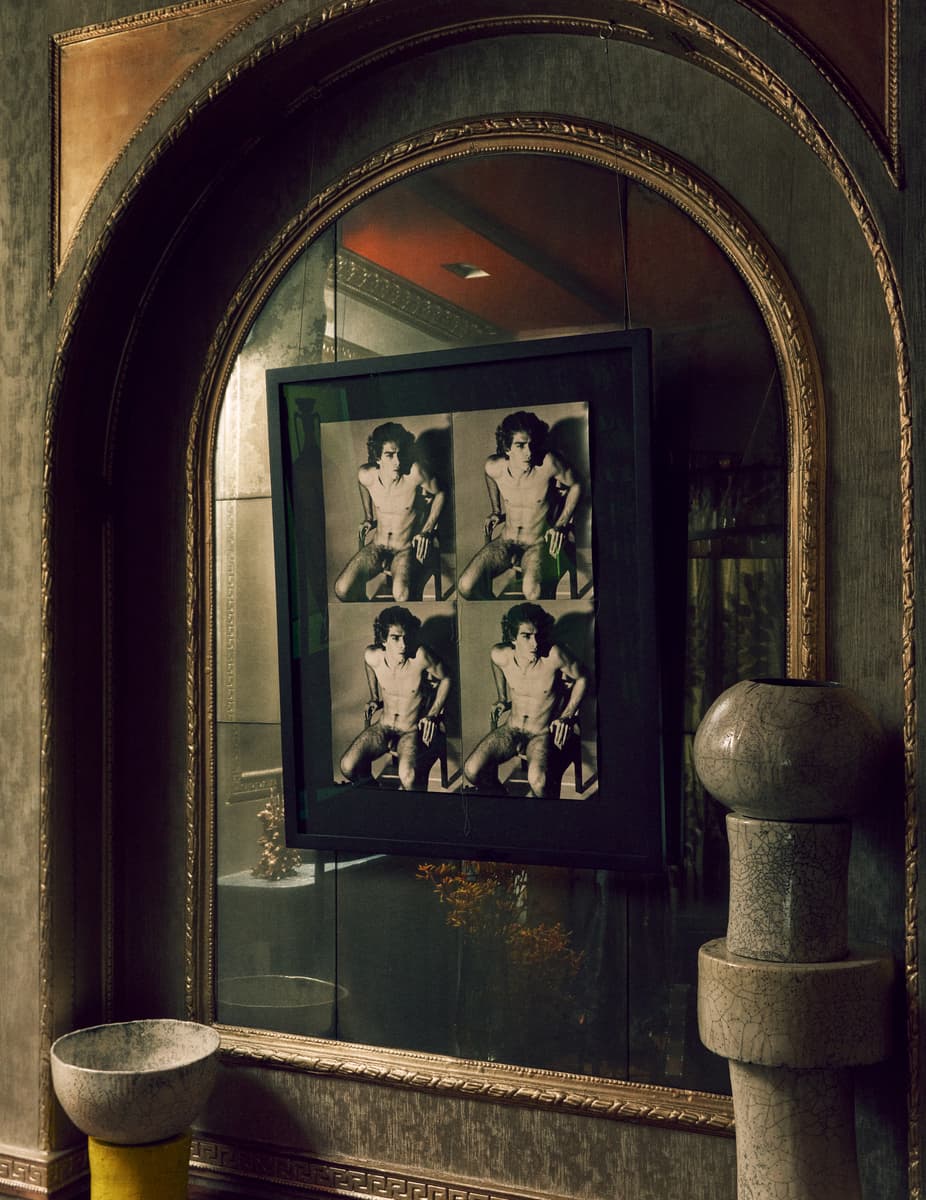
MALE NUDE (FL 05.00015)
ANDY WARHOL
Warhol had long explored the erotic male body, from early drawings of male nudes in the 1950s to films like Blow Job (1964) and Flesh (1968). His Torso series (1977) and Sex Parts paintings (1978) pushed this further, directly engaging with gay eroticism. By the 1980s, photography had become Warhol’s primary medium for documenting sexuality, leading to the creation of explicit Stitched Photographs (1977–1987), among his final artistic experiments, combining photography, mechanical repetition, and physical stitching. While many of these works featured portraits, self-portraits, and everyday objects, a lesser-known subset explored explicit sexual imagery, reflecting Warhol’s long-standing engagement with eroticism and queer identity. Warhol had a deep appreciation for classical beauty and drew inspiration from various periods of art history when photographing the nude. His work reflects influences from classical sculpture, Renaissance art, and the pioneering nude photography of Wilhelm von Gloeden—one of the earliest and most influential photographers of the human form. In the 1980s, Warhol translated these artistic references into his own photographic practice, producing silver gelatin prints that he meticulously arranged into grids of four, six, or nine identical images, stitched together to create a striking visual repetition. Many of the Stitched Photographs that do not have sexual subjects were publicly exhibited only once during Warhol’s lifetime, at Robert Miller Gallery in January 1987 - his only solo photography show - six weeks before his death.
PRICE: POA
PRODUCT DETAILS
ARTIST: ANDY WARHOL
MATERIAL: FOUR STITCHED GELATIN SILVER PRINTS
W: 54.3 x H: 69.9 IN CM